This artistic-cultural mediation initiative seeks to bring cinema closer to people with a physical/ mental or neuro-atypical disability. As part of this festival, several documentary films (short and medium-length films) will be broadcast in connection with the experiences of these people.
One of the few Sci-fi and Fantasy Film Festivals in Eastern Europe, that brings a fresh concept of gathering together, through live video streaming, the film crew and the film consumers. The festival has film screening, conferences, debates and happenings. It will have Jury Awards and Popular Awards, for four categories (Sci-Fi, Fantasy, Animation, Comedy/Parody, Documentary, AI film) for short and feature films.
Following the success of its first three editions, we are now organizing the 4th edition of the Majadahonda International Social Film Festival (MISFE’27). The festival is founded on the belief that cinema can be a powerful tool for social transformation and that, by encouraging the circulation of high-quality, thought-provoking films, we can help educate and raise awareness within the community about important social issues.
MISFE’27 continues to establish itself as a showcase for filmmaking talent that addresses and brings attention to relevant social issues. We believe that films can serve as educational tools and as catalysts for dialogue around subjects that matter.
The festival also aims to contribute to the cultural development of Majadahonda and to broaden and enrich the town’s cultural programme. The diversity of films presented at MISFE enhances the cultural life of the community by exposing local audiences to different stories, perspectives and forms of artistic expression.
We believe cinema has a unique ability to move us emotionally and awaken empathy. The festival therefore gives us the opportunity to connect more deeply with stories that reflect the diversity of our experiences and inspire us to understand and appreciate the richness of the human condition.
Through the short films taking part in this fourth edition, we will explore and celebrate diversity in all its forms — cultural, social, racial and beyond. By bringing diverse narratives to the forefront, the festival seeks to promote inclusion and mutual understanding, building bridges between communities.
The selected films will not only entertain, but also inspire and provoke thought. Through stories of resilience, social awareness, activism and positive change, the festival will provide a space for sharing ideas and opening conversations.
For this fourth edition of MISFE, we are continuing our parallel School Cinema section. During the first three editions of the festival, the “Sonsoles San Román” Award was presented to the Best School Cinema Short Film. This year, we want to increase participation from primary and secondary schools, sixth-form colleges, vocational training institutions and specialist educational centres.
For the first time, MISFE will also introduce a Best Documentary category, as we believe documentary filmmaking is particularly closely connected to the festival’s social focus.
Philosophical Film Festival / Филозофски Филмски Фестивал is a unique film festival that lives on the crossroads between philosophy and film and is held annually in Republic of N. Macedonia. On one side, the festival tries to promote the idea of film as a medium which can provoke philosophical thought and illustrate philosophical ideas. On the other, it aims to trigger aesthetical analysis’ and investigations into film language as a form sui generis and empower young filmmakers and film workers to reflect on key concepts, questions and ideas in order to translate them into the visual language of cinema. It is a pioneering festival of the kind in Macedonia and the region, and one of few in the world connecting film and philosophy.
Newcastle International Short Film Festival or NiSFF is an IMDb registered short film festival open to submissions of short films in multiple genres and categories from international, Australian and regional New South Wales (NSW) film-makers. Finalists for the best film in their regional category will be screened at the Royal Exchange Hybrid Performance Space/Cinema in Newcastle Australia in mid November each year. The overall Best Short Film winner will be selected from all the various category winners regardless of its length.
No screening fees are paid to selected films and no DCP is required. If your film is understandable for a mainly English speaking audience without subtitles then English subtitles are not required.
UMOREA LAB is a short film laboratory and forum organized by Lanbarri Association within the framework of the Arrigorriaga Short Film Festival “Humor en Corto”.
Looking through the eyes of directors from all over the world is the goal of our Festival.
A global vision on free and independent cinema, without genre limitations and any form of censorship. The creator of the project is producer and director Luigi Pastore, already artistic director of the Italian Horror Fantasy Fest, who proposes a new concept of Festival capable of creating interaction between the authors and the public.
PUFA (Pucela Fantástica) is an international fantastic and horror Film Festival that takes place in Valladolid (Spain), open to short films of less than 30 minutes and feature films of more than 60 minutes, from each country (with synchronized subtitles in Spanish or English), of the fantastic genre, science fiction, horror, fantasy, thriller/suspense...
TerraLenta Film Fest is an international film festival dedicated to environmental documentaries. The Festival is based in Pignola (PZ) in Basilicata, Italy.
The aim of the Festival is to promote independent and author documentary cinema, raise public and community awareness of environmental issues, foster cultural spaces for dialogue and learning, support multimedia research, and encourage eco-sustainable actions. TerraLenta is the intention to bring original artistic forms and offbeat culture, the experimentation of new ways of disseminating environmental issues through art and research. We believe that it is necessary to give space to a different form of divulgation, so critical, innovative and far from formalising; that's the reason why we set ourselves to support subjects with authentic contents and modes of expression.
The Festival was founded in 2024 as the evolution of a long-standing experience in the dissemination of cinema on environmental themes through independent film review in the high mountains (OasiCinema Festival), in order to promote the symbiosis between visual art and environmental research in unusual contexts, deliberately different from urban spaces.
TerraLenta Film Fest will take place in July, from 1 to 5, 2026. This will be its second edition, offering a unique opportunity to explore the world of cinema with a focus on environmental themes. The festival will take place in several fascinating locations, such as the historic center of Pignola (PZ), where the screenings will be held outdoors, and some historic buildings, including Palazzo Gaeta, which will serve as the festival's main headquarters.
In addition to the film screenings, the event will feature important moments of insight, such as seminars and educational workshops centered on the environment and related themes. The guests of the festival will have the opportunity to present their works and engage in discussions with the audience. The official festival program will be made available on May 18, 2026, allowing participants to learn about the scheduled events in detail.
This is an unmissable occasion for film enthusiasts and those interested in ecological and sustainability issues, set in the charming context of Southern Italy.
Bayelsa International Film Festival - BIFF is established with aim to engage filmmakers, artists, performers, academics and members of the creative community to unravel the delicacies of diversities and locate common grounds across cultures and societies.. To provide an exciting, educative, and information oriented Film Festival.
Bayelsa International Film Festival - BIFF is established with aim to engage filmmakers, artists, performers, academics and members of the creative community to unravel the delicacies of diversities and locate common grounds across cultures and societies.. To provide an exciting, educative, and information oriented Film Festival.
Bayelsa International Film Festival - BIFF is established with aim to engage filmmakers, artists, performers, academics and members of the creative community to unravel the delicacies of diversities and locate common grounds across cultures and societies.. To provide an exciting, educative, and information oriented Film Festival.
BIFF is designed to be an intimate and eloquent filmmaker festival where film enthusiasts can get first hand insights from directors, writers, actors and producers from the premiering films. With commitment, BIFF will be presenting an annual film festival and art exhibition to provide both professional and amateur filmmakers with a space for display and dissemination of their works. At the same time, a strong focus on the BIFF as a place for the world to discover recent talents in African films and filmmakers. The event also offers master classes, panel discussion and workshop to augment this diverse programming.
The International Unseen Film Festival 'Social Films' from Bilbao (Basque Country, Spain) is organized by Kultura, Communication y Desarrollo KCD NGOD; Organization dedicated to promoting a human, intercultural, equitable and sustainable development through Communication and Culture.
The International Unseen Film Festival 'Social Films' from Bilbao is an annual celebration dedicated to show a cinema full of diversity and social commitment, a cinema that is usually excluded from commercial screens.
The Festival is centered on four major themes: Sustainable Development, Human Rights, Interculturality and Gender Equity.
With its continuous work, it has become an indispensable appointment for all those interested in communication for development and social transformation.
The Festival is also a recognition of all people who make a communication that allows to reflect through their audiovisual works all those different causes and problems of humanity.
The purpose of the festival refers to awareness of both the external filters on the screen, including censorship (commercial, ideological, aesthetic), and the internal filters of screen perception and projection, including self-censorship. NEFILTRAVANAE KINO is an exploration of aestheticization and commodification in art. The next aim of the festival is to expose the complexity, manysidedness, and variety of filmmaking.
NEFILTRAVANAE KINO (NoFilter Kino) is a film festival that is held by the Short Movie Club, the platform for cinematic projects. NEFILTRAVANAE KINO is ADAMI Media Prize qualified festival. The International Film Studies Conference is held at the same time as the film festival. In this way, film theory and practice are integrated together at the NEFILTRAVANAE KINO.
Originally the festival was held in Belarus, but because of political repression and publicly stated anti-war stance, screenings and events can be held in different countries. First of all in Poland (Warsaw), Germany (Berlin, Hamburg), Lithuania (Vilnius). For example, the 11th and 10th Nefiltravanae Kino took place in Warsaw, Berlin, Hamburg, Vilnius and Helsinki. The content of past years' film programs can be found on the website https://shortmovie.club/programmes/
The festival will be held in a hybrid format. We will have a part of live screenings and online screenings on a video platform https://film.nofilterkino.org/ . The video is cryptographically secured. In addition, we pay attention and promote films from our previous years that are released to the public on the Internet after their festival curcuit.
Nefiltravanae Kino involves theater, artists to interpret symbols and history. We work with the audience's reaction and participants' as well.
--------------------------------------------------------
The concept of the NEFILTRAVANAE KINO (NoFilter Kino):
ALIENATION PROBLEM
We live in a world of malls and cinema multiplexes. We see that indie cinema and non-commodity art go to the periphery of public attention. Primitive attractions replace the cinematography. The escape audience is alienated behind the big screen. So modern mainstream cinema is part of a manipulating tool that leads to the society of alienation. Thus the tendency is that indie cinema becomes more unreadable for the wide audience. We should understand the context of the filmmaker to understand the independent cinema. That is why the NEFILTRAVANAE KINO concept implies the physical presence of filmmakers.
FILM SELECTION PROBLEM
Filmmakers shoot millions of movies. And thousands of short film festivals organize screenings all over the world every year. On average, several thousand films are submitted to a film festival. So various good films can be neglected for whatever reason. Often selecting probability is like winning a lottery. As a result, filmmakers are left with no feedback. It is a paradox that no one can hear you in the age of the Internet! The mainstream culture prefers attractions and casual viewing.
Also, this idea is based on the film selection problem. Perhaps it’s no surprise one person, i.e. programme director at best, or even students of film schools make a preliminary decision to select a movie. Сoncordance of judges or previewers is more seldom thing than the difference of background, tastes. So selection or judging can be one-sided or perfunctory. It is not bad as the programme director has a good taste and aesthetic sensitivity, of course. But we’ve discovered another conception of “unfiltered cinema”. We matched it against “the best of the best” way. This way aids to perceive cinematic idiom without the dictate of art-curators.
CELEBRATION OF INDIE CINEMA
So the NoFilter Kino tries to avoid “the best of the best” way but it does not ignore it completely, sure. The festival selects fiction, animation, documentary, experimental and virtual reality sections. A jury awards the best film in every section. The festival holds the screenings at cinema theatres, the National Centre for Contemporary Arts, and art-spaces.
Our aim is to gather people in art, to have a dialogue to be happy with smart communication.
Cinema is art but not sport. The key point of our project is to establish communication between the filmmaker and the audience.
Please, read about the festival history through the link to the festival's website. http://shortmovie.club/history/
10 Years Already!
Art District Radio & 20MAX TV are organizing the 10th edition of their short film festival, "Festival du Court d’Art District," with an open theme this year. The festival will take place on March 19, 2027, at the L'ENTREPÔT cinema in Paris.
To mark the festival's 10th anniversary, a special selection will bring together the 9 most outstanding films from among the winners of the jury, audience, and jury's choice awards from the previous 9 editions, along with the winner of the 2027 jury prize. These 10 films will be screened and submitted to a joint vote by the jury and the audience.
As usual, the festival is open to short films with a maximum duration of 1 to 20 minutes, produced after January 1, 2024. Film genres include fiction, animation, documentary, etc. Filming equipment, such as cameras and smartphones, is free to use. Films shot in a language other than French are eligible to compete provided they are subtitled in French. At least one representative per film must be present for the entire evening of the festival.
The nineteenth version of the Muestra Cine + Video Indígena, organised by the Museo Chileno de Arte Precolombino, opens its call for entries from 21 November to 7 March 2026 to films by indigenous and non-indigenous filmmakers whose central theme is indigenous peoples, especially in Latin America.
The curatorial committee of the festival will place special emphasis on selecting works that portray cultural and territorial aspects of these nations, such as: processes of safeguarding cultures, protection and defence of territories and the environment, human rights, identity tensions and political reflections. In addition, works spoken in indigenous languages and which have been made in a participatory manner with indigenous communities or through the training processes of indigenous film schools will be highlighted.The nineteenth version of the Muestra Cine + Video Indígena, organised by the Museo Chileno de Arte Precolombino, opens its call for entries from 30 November to 7 March 2025 to films by indigenous and non-indigenous filmmakers whose central theme is indigenous peoples, especially in Latin America.
The curatorial committee of the festival will place special emphasis on selecting works that portray cultural and territorial aspects of these nations, such as: processes of safeguarding cultures, protection and defence of territories and the environment, human rights, identity tensions and political reflections. In addition, works spoken in indigenous languages and which have been made in a participatory manner with indigenous communities or through the training processes of indigenous film schools will be highlighted.
We are excited to announce our call for entries for the 2027 Adriatikino edition. We are looking for short films based on celluloid film or other analog media, with no boundaries on genre. Experimental work, found footage and mixed media are welcome, as well as any cinematic language that challenges the orthodoxy.
Adriatikino is an in-person screening organized by local filmmakers in collaboration with Luma Experimental Film Lab and Teatro Nuovo di Capodarco in Fermo (Italy), close to the Adriatic Sea. Inspired by its historical spirit of connecting cultures, Adriatikino aims to be an encounter to nourish a film-loving community, to promote exchange between filmmakers and film lovers, as well as to spread analog film practices.
The event includes screenings, workshops and other events. The movie theater Teatro Nuovo di Capodarco is the main venue for the screening. Luma Experimental Film Lab is a second venue and a film workshop promoting darkroom experience.
We are seeking short films that use celluloid film or other analog media, no longer than 15 minutes. Once again this year, we have a special category for super short films, with a duration of up to 1 minute.
Ostia International Film Festival 2026
28/30 Aug 2026
promotes and spreads all the activities relating to the world of Cinema, including through TV, Streaming, Theatre, the Web, and Social Media.
Purposes:
In collaboration with public and private entities, the promotion and spreading of culture, cinematographic and artistic production, and of the audiovisual works submitted every year to the Festival;
organize happenings, shows, events, and exhibitions related to the Audiovisual, Artistic, and Cultural sector at national and international levels through the Festival;
bring together and promote the training of people and artists of any age and social background involved in creative film and audiovisual production;
Create works connected to the world of Cinema, Art, Photography, and Culture in general.
ORGANIZERS
Cultural Association Time & Memory organizes the fourteenth edition of the Short Film Festival called "SHORT TO SOUTH", to be held in Polla (SA)ITALY from the 20 - 21 June 2026 at the Auditorium "Holy Nicolicchio".
“RIETI & SABINA Film Festival”
25 NOV 2026
The “RIETI & SABINA Film Festival” aims to provide an opportunity for audiences to discover talents, Authors, Actors, Directors, and Filmmakers, to foster synergies between Film Professionals and emerging talents.
FEMCINE was created to discover and support the work done by female filmmakers and to share films with gender-based subjects with a broader audience. FEMCINE invites female directors from Chile and the rest of the world to participate in one of its three competition categories: International Feature Length Competition, International Short Film Competition, and the Chilean Film School Short Film Competition.
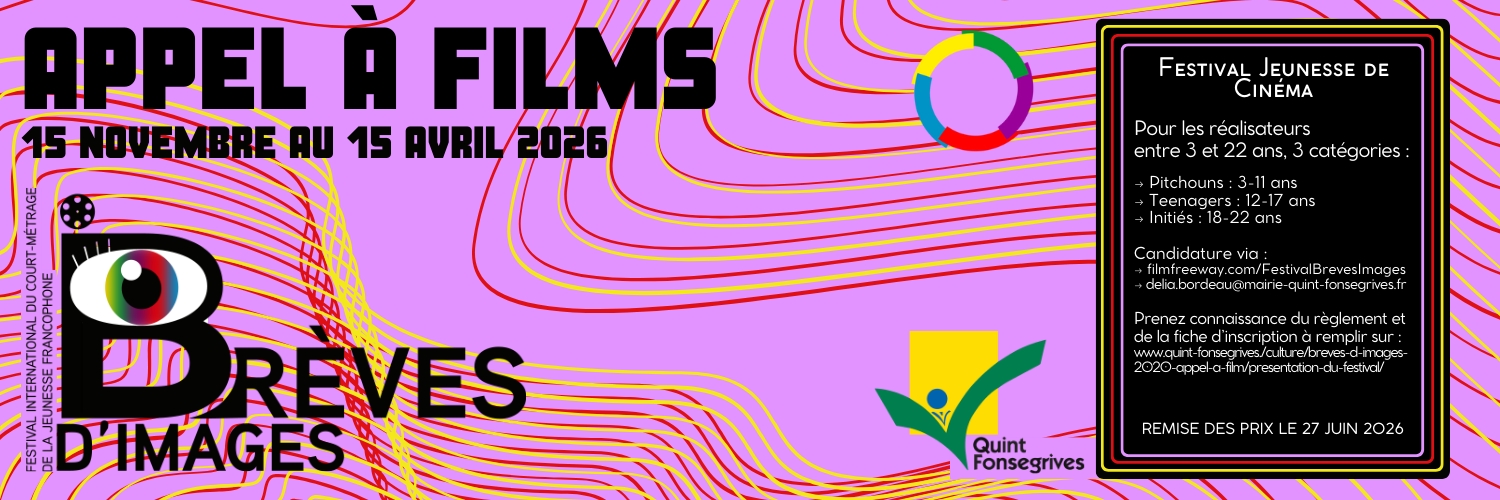
Brèves d’Images, the International Short Film Festival of Francophone Youth, dedicated to young people in Occitanie!
The festival highlights emerging talents aged 3 to 22, offering them real visibility for their short, original, and socially engaged works.
Brèves d’Images encourages both individual and collective projects, allowing young creators to explore every step of the filmmaking process: scriptwriting, shooting, editing, sound mixing… It also serves as a genuine springboard for aspiring filmmakers.
Every year, the festival begins with a call for projects.
Once submissions close, all received films are viewed and preselected. This preselection is far from trivial: it can lead to increased visibility on the festival’s social media, publication on the official YouTube channel, and sometimes even screenings during special sessions.
A jury composed of professionals from the fields of cinema, culture, and audiovisual media then meets to view the preselected films. This jury establishes nominations in various categories (Best Directing, Best Screenplay, Best Music, etc.) and determines the final awards.
Each year, activities related to filmmaking are offered for both young participants and the general public.
The highlight of the festival is the closing day, a key moment of sharing and celebration. During this festive and friendly event, the award winners are honored in a prize ceremony and invited to speak with the audience about their experiences as young directors, screenwriters, and actors.